


The Stockade Historic District is the oldest continuously inhabited neighborhood in Schenectady, New York, tracing its roots to the 17th century along the north bank of the Mohawk River. Bounded by the river to the north and featuring one of the nation’s richest concentrations of colonial-era homes, the Stockade has evolved from a fortified settlement into a densely built residential district prized for its historic character and strong community fabric.
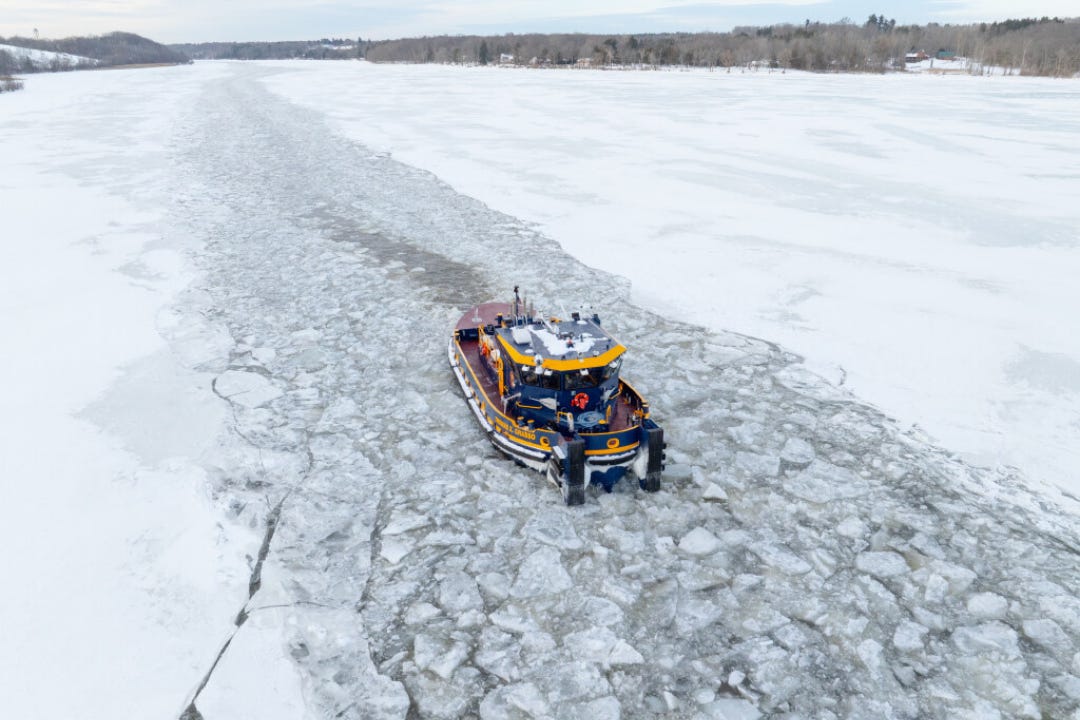
Because much of the Stockade lies on a low-lying plain directly adjacent to the Mohawk, it has long been susceptible to periodic inundation and ice-related flooding. Seasonal snowmelt, storm surges, and especially ice jams have repeatedly pushed water over the riverbanks and into streets and basements throughout the neighborhood. That vulnerability is where the New York State Canal Corporation’s newest tugboat, Thomas X. Grasso, comes into play.
“We’re breaking up the ice on the river between Locks Seven and Eight,” said Jeff Gritsavage, Division Canal Engineer. “Ice can dam up against the railroad bridges leading into the Stockade neighborhood and, left unchecked, it can lead to flooding.”
Ice has long been a problem along the Mohawk, and over the years people have tried nearly everything to keep the river moving and the streets of the Stockade dry. On two separate occasions — once in 1914 and again in 1954 — town officials even resorted to using dynamite to break up ice jams.
“I’m not sure that it worked too well,” Jeff said. “It broke a lot of windows, but that was about it!”
The current ice-breaking effort marks a first for the Canal Corporation, made possible by the addition of powerful new tugboats like the Grasso and its sister ship, the Rome.
“We had a tug, the Erie, that did some limited ice breaking in the Utica section just to clear the area,” Jeff said. “And I think the Grover Cleveland may have done some ice breaking back in the day when the Canal stayed open later in the season. But nothing on this scale. This is a first.”
The Grasso’s approach to ice breaking isn’t about simply smashing its way through the river. Instead, it involves making a series of passes upstream and back down again, agitating the ice and carving it into smaller pieces so that, when the river thaws, they can float away with the current. The goal is to reduce the ice into chunks small enough to pass safely through obstacles such as bridge piers and railroad trestles.
“If the pieces are four feet wide, that’s not a problem,” Jeff said. “But if you get a piece that’s sixty feet wide, or even less, and it’s structurally strong enough, it will block the flow.”
It’s a challenging task, Jeff noted, and one that requires constant awareness and confidence in the vessel’s performance.
“A rescue out here would be challenging,” he said. “It’s not like a car where you can just pull over and call AAA. You have to be sure-footed and always alert. I can recall one situation just standing on the dock where the wind was blowing 12 to 14 knots (approximately 14 to 16 miles per hour), and it almost blew me right off. You always have to be aware of the conditions and your surroundings.”
The plan moving forward is to continue ice breaking along the Mohawk and, eventually, to bring the Rome and other new tugboats onto the Canal system during future winters. As Jeff sees it, this effort represents the beginning of a long and beneficial relationship between the Canal Corporation, the people of Schenectady, and communities throughout New York.
“It’s a unique mission,” he said. “And we haven’t had any flooding in the Stockade neighborhood since we started doing this. That’s a good feeling. We’re out here looking out for the community and trying to prevent what could be a real problem.”
Watch an exclusive video of the ice breaking in action below!