


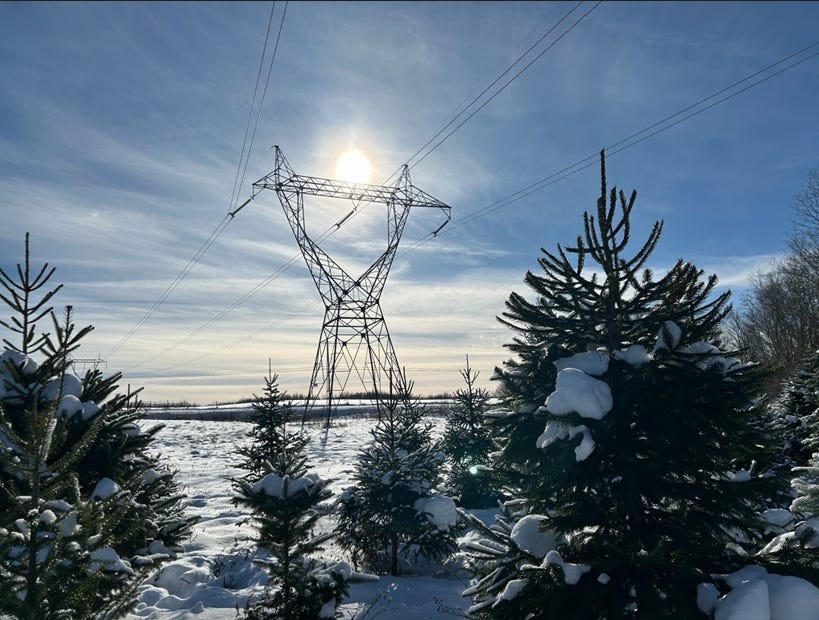
For those who celebrate Christmas, picking out a tree is a long-standing holiday tradition. Sometimes, finding the perfect tree can turn into an all-day quest. To help ease this holiday hustle, NYPA has partnered with local farmer Don, who uses one of the rights of way (ROWs) in Marcy, a town located in central New York’s Mohawk Valley.
“Originally, this was a dairy farm when we bought it,” Don recalls. “But the cows were breaking out and getting hit by cars! So, we switched to Christmas trees, and for the last 30 years, we’ve been planting them under the transmission towers.”
When Don decided to move to trees instead of cows, NYPA’s only concern was the height of the trees. It’s crucial for NYPA to keep the areas around their power lines clear of tall vegetation. To manage this, they use Integrated Vegetation Management (IVM), a method that combines cultural, biological, and physical techniques to control plant growth.
“Typically, when we manage vegetation around power lines, we aim to keep tall-growing trees out of the area,” said Lew, NYPA’s manager of ROW and Environmental. “We collaborate with landowners, enabling them to use the land for activities like crop farming, pastures, orchards, or Christmas tree farms. Christmas trees, for example, only grow to about 15 feet, which keeps them from interfering with power lines.”
NYPA has an easement with local landowners, which allows the landowners to use the land for specific purposes, such as growing a Christmas tree farm, as long as these activities do not interfere with the operation and maintenance of the power lines. While the landowners retain ownership, NYPA has the right to access the land at any time for inspections, maintenance, and vegetation management. The landowners must ensure that NYPA’s access is unobstructed and may need to obtain permits for certain activities. This arrangement ensures that NYPA can perform necessary work while enabling the landowners to utilize the land for their needs, like a tree farm.
Working alongside John, a senior regional staff forester, Lew takes land stewardship seriously. To him, it’s a shared responsibility with the landowners, and NYPA works hard to forge strong partnerships with them. The goal is always collaboration, creating a desirable environmental space while ensuring the land serves NYPA’s needs.
“We collaborate with landowners who have Christmas tree farms, apple orchards, pastures, and croplands,” Lew explained. “This partnership allows them to use their properties while ensuring we can manage the land without any issues.”
From Don’s perspective, the partnership with NYPA has been positive from the start, and he hopes it continues for years to come.
“We’ve had an excellent relationship with the Power Authority over the years,” he said. “If you need something, they’re always there, and we work well together. If I have any questions or concerns, they’re always ready to meet with me and work things out.”
In addition to bringing holiday cheer to local families once they’re cut down and sold, the Christmas trees—a mixture of firs and spruces—provide significant environmental benefits year-round. The trees capture and store more carbon from the atmosphere than areas with low-growing plants and offer habitats for small mammals and deer. Because of this, Lew and John take great care in maintaining the ROWs, balancing nature and technology.
“We don’t run a scorched earth program,” Lew explained. “We don’t just mow or spray everything. Instead, we selectively target only what could interfere with the power lines, leaving grasses, plants, small shrubs, and yes, even Christmas trees! This approach creates a rich and varied environment with new growth that benefits small mammals, insects, pollinators, birds, and other wildlife.”
NYPA’s commitment to sustainability doesn’t stop with Christmas trees. In other efforts to green the state, NYPA’s 2025 Tree Power program recently delivered 1,650 trees to 49 low-cost energy and energy efficiency customers, bringing additional sustainability benefits to municipalities and state agencies throughout New York. This year marked the largest distribution since the program began in the late 1990s, offering incentives for plantings in disadvantaged areas. This contributes to Governor Hochul’s goal of planting 25 million trees by 2033.
NYPA’s Environmental Justice team also led a group of volunteers in a community tree planting event with the Town of Niagara on Nov. 3. Volunteers joined a landscaping vendor to plant 12 native trees adjacent to a town parking lot.
Through these initiatives, NYPA continues to demonstrate its dedication to environmental stewardship and community engagement, ensuring that both present and future generations can enjoy a greener, more sustainable world.
John sees the Christmas tree farm as another example of how NYPA strikes a balance with local landowners, letting them use the land for their needs while maintaining the integrity of the system. “It’s wonderful to know that the trees being cut down will be used to brighten local homes this season,” he said.
“This is one of the rewards for me as a forester,” John added. “It’s good to be able to find a way for these trees, once they’re cut down, to be used for something that the people in our community can use, enjoy, and appreciate. Any opportunity to do what we can for our neighbors is awesome.”